Quick Answer
For a first visit, we recommend checking the MTR route before considering a bus transfer. After clearing the border at Futian Checkpoint, your Hong Kong starting station is Lok Ma Chau. MTR’s trip planner currently estimates 50 minutes to Mong Kok, changing at Kowloon Tong. Adult standard-class fares are HK$45.4 with Octopus or HK$48.0 for a single-journey ticket, checked October 9, 2026. These figures do not include immigration queues or walking through the checkpoint. Check the MTR journey.
Do not plan a holiday crossing around a guaranteed queue time, or assume a social-media fare applies to your payment method. If you will return to Shenzhen, check your permission to re-enter mainland China before leaving it.
Evidence and limits (checked October 9, 2026): The MTR time and fares above are dated train estimates, not a timed door-to-door journey. This specific route was researched from operator and immigration guidance, not personally timed. Check current border hours, train service and fares, and your permission to enter Hong Kong and return to mainland China before traveling.
First, Make Sure You Mean Futian Checkpoint
Futian Checkpoint is the pedestrian border crossing connected to Hong Kong’s Lok Ma Chau Spur Line Control Point. It is not Futian Railway Station, where high-speed trains depart for Hong Kong West Kowloon. If you have a high-speed rail ticket, use our Futian to West Kowloon guide instead.
There is also a separate road crossing called Lok Ma Chau. Its operating arrangements must not be confused with the Spur Line crossing. The Hong Kong Immigration Department lists the Spur Line control point’s regular hours as 6:30 a.m.–10:30 p.m. Those hours are not an invitation to arrive at the closing minute.
If you have not chosen a crossing yet, compare the Shenzhen–Hong Kong border crossings before committing to this route.
Getting Through the Border
Follow current signs for Hong Kong departures and the instructions for your travel document. Complete mainland departure and Hong Kong arrival procedures before continuing to onward transport. The two sides are connected by a passenger bridge; this is not a sea crossing. The official boundary-rail description explains the connection.
Many Chinese-language walkthroughs show mainland residents using an Exit-Entry Permit for Traveling to and from Hong Kong and Macao. That is not a universal procedure for foreign passport holders. Check your Hong Kong entry requirements and follow the appropriate visitor channel; automated clearance has separate eligibility conditions. See the official immigration-clearance guidance.
Keep your passport and any required supporting documents accessible. Follow screening instructions for all bags rather than assuming a small backpack is exempt. Save your destination address and transport plan offline before joining the queue, and confirm that your mobile plan covers Hong Kong.
The MTR Route to Mong Kok
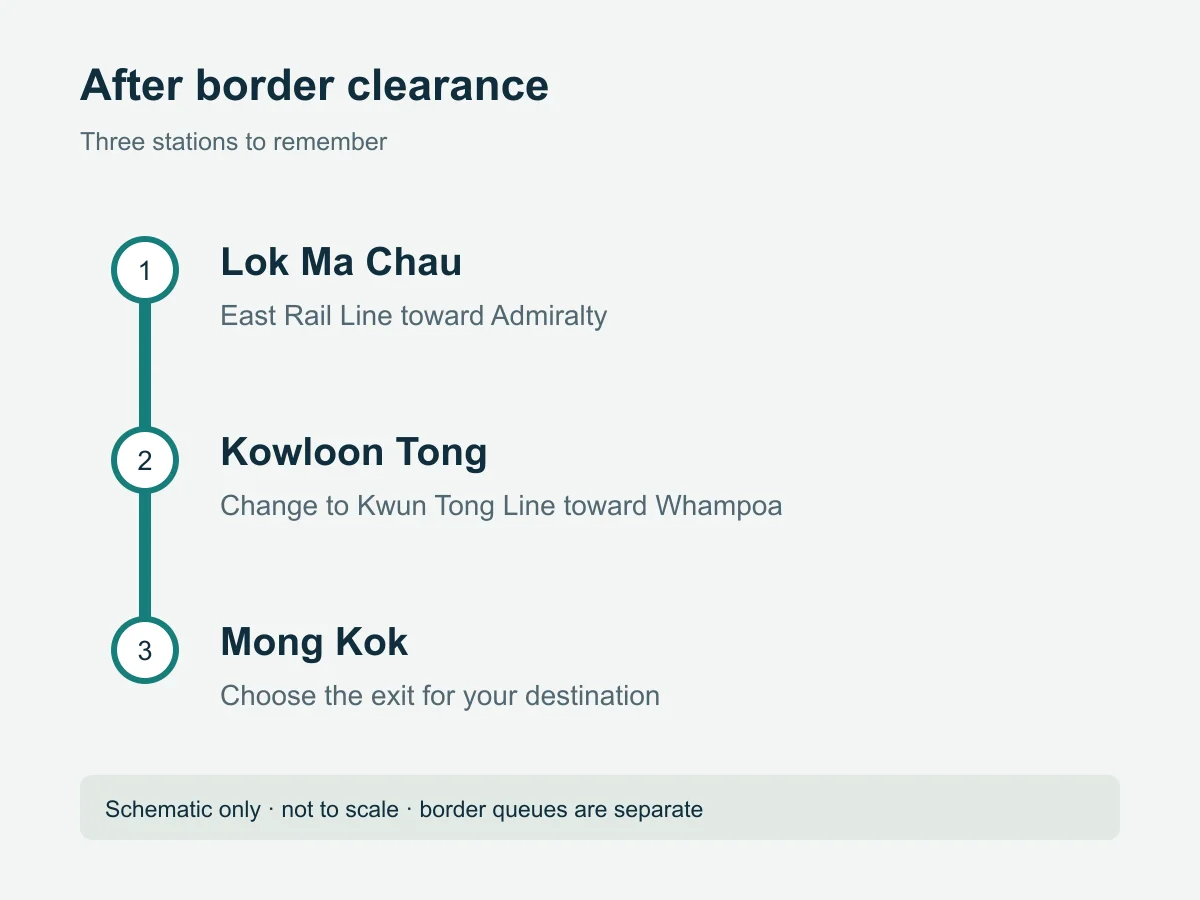
After immigration, follow signs to the MTR rather than following someone heading for the bus interchange.
- At Lok Ma Chau, board the East Rail Line toward Admiralty.
- At Kowloon Tong, change to the Kwun Tong Line toward Whampoa.
- Get off at Mong Kok and choose the exit closest to your destination.
This is the route returned by the MTR planner on the review date. Stay in standard class unless you deliberately arrange the first-class fare.
Mong Kok and Mong Kok East are different stations. The latter is on the East Rail Line. Compare your actual address against both stations instead of choosing solely by the word “Mong Kok”; a different arrival station may change your final walk.
How Long Does the Whole Trip Take?
The railway estimate in the Quick Answer is only one part of the journey. Your full trip consists of:
- Reaching the departure hall on the Shenzhen side.
- Queuing, immigration checks, and walking through the border facilities.
- Reaching the platform and completing the railway journey.
- Walking from your arrival station to your hotel, restaurant, or meeting point.
Do not interpret the train estimate as a checkpoint-to-restaurant arrival promise. There is no reliable single total for every traveler, particularly when a document check, crowded hall, or unfamiliar transfer adds time. Keep the first activity after arrival flexible rather than booking something that starts immediately after the estimated train arrival.
How Much Should You Budget for Transport?
Use the adult standard-class fares above as a dated reference, then check the planner again before traveling. Keep the budget in Hong Kong dollars, not an unlabeled number copied from a mainland payment screenshot. A wallet’s renminbi settlement amount is not the same thing as the operator’s published HK-dollar fare.
Do not assume a tourist pass, contactless bank card, or QR payment is charged exactly like Octopus. Check the rules for the ticket or payment product you intend to use, including any restrictions on journeys to border stations.
What About the B1 and 268X Bus Route?
The Transport Department lists B1 among the buses serving the Lok Ma Chau Spur Line interchange. KMB has also published a boundary-route interchange scheme linking B1/B9 with designated routes, including 268X for Mong Kok, Yau Ma Tei, and Jordan. This establishes a route option to investigate, not a verified promise that today’s whole journey costs “13.91.” Transport Department access guide; KMB interchange document.
The linked KMB document is dated 2024. We have not verified the current transfer stops, fare, or interchange conditions, so this guide does not recommend B1 plus 268X as a ready-to-follow alternative. Do not use the old document as a current fare quote or follow the social post’s staircase-by-staircase directions without checking today’s arrangements with KMB or App1933.
If you cannot confidently identify both bus stops, use the verified rail route rather than making a tight connection depend on an old photograph.
How Long Are Morning Border Queues During the National Day Holiday?
Treat National Day as a busy-travel scenario, not an ordinary weekday. Immigration warns of longer waits during holidays and peak travel periods; 9 a.m. does not guarantee a short queue. No source checked for this guide supports a fixed “just add 20 minutes” allowance. Official control-point advice.
For a future October 1 trip, check that year’s notices, not a previous year’s comment thread. Avoid a nonrefundable morning activity whose timing depends on a quick crossing, and agree on a meeting plan that still works if one traveler clears later than another.
Do You Need to Exchange Hong Kong Dollars Beforehand?
Our practical recommendation is to carry a modest cash backup in Hong Kong dollars rather than relying on one phone wallet for the whole day. That does not mean you need to exchange your entire budget in advance, or that a checkpoint exchange counter is necessarily the best option.
Check your transport payment setup before departure. MTR provides separate information for Octopus, QR tickets, and contactless bank cards; eligibility and charging rules differ. Its contactless overview, for example, explicitly excludes UnionPay debit cards from that product. Check the MTR contactless information rather than assuming every foreign card can be tapped at the gate.
If exchanging cash, compare the amount of HKD you will actually receive after fees. We have not verified the operating hours or rates of the exchange counters described in the social posts. Nor should a mainland visitor’s successful wallet payment be treated as proof that your overseas account will work in the same way.
Can You Arrive by High-Speed Rail and Return Through Another Crossing?
Generally, yes for an ordinary visit, provided your documents permit the return entry. You do not normally have to retrace the same transport route: arriving at West Kowloon and returning through an operating land crossing are separate journey choices. Hong Kong Immigration lists the available entry and exit control points.
For foreign visitors, the crucial question is mainland re-entry eligibility, not simply whether a bus or train is available. A mainland–Hong Kong–mainland trip requires a valid basis for the second mainland entry. A single-entry visa already used for the first arrival does not cover another entry on that visa. Confirm an unused entry on a still-valid visa, an applicable exemption, or another valid authorization. The Chinese Visa Application Service Center’s explanation of visa validity and entries, dated August 28, 2026, explains that a visa is no longer valid once its permitted entries are exhausted or its validity expires. Admission remains subject to the decision of the border inspection authorities.
Do not treat 240-hour visa-free transit as an automatic workaround; it has its own itinerary and designated-port conditions. Consult the National Immigration Administration’s transit policy if that is your intended entry basis.
Once eligibility is clear, plan the Hong Kong to Shenzhen return journey separately. Check the destination shown on the northbound train: the East Rail Line has both Lo Wu and Lok Ma Chau branches. Verify the relevant last service, and allow time to complete clearance before the chosen crossing closes.
Before You Leave Shenzhen
- Confirm Hong Kong entry and any planned mainland re-entry permission.
- Save the exact Mong Kok destination, not just the district name.
- Check current MTR fares and your return service.
- Prepare a working transport payment method and a backup.
- Save essential directions offline and leave flexibility around border queues.
Sources and Review Date
Official sources were checked on October 9, 2026. Three reader-supplied social posts and their comments helped identify the questions; they were not treated as proof of immigration rules, current fares, or universal payment compatibility. No creator photographs are reproduced.