If visa-free entry and 240-hour visa-free transit do not fit your passport, purpose, route or planned stay, check the ordinary tourist (L) visa instructions published for where you legally live. Do not rely on a worldwide document checklist: the responsible office, required evidence, submission channel, fees and fingerprint rules can differ by jurisdiction and can change.
Last official-source check: September 16, 2026. This guide explains a safe application workflow, not a guaranteed result. Recheck the Chinese embassy, consulate or Chinese Visa Application Service Center serving your legal residence on the day you prepare and submit your application.
Quick Answer: Do You Need a China Tourist Visa?
Before starting an L-visa application, check whether your trip qualifies for visa-free entry to China. If you are travelling through mainland China to a third country or region, separately check the route conditions in our 240-hour visa-free transit guide. Those options have their own nationality, purpose, route, port and stay rules.
If neither route applies—or if your planned trip falls outside its conditions—the ordinary L visa is the standard category for tourism. Your first task is not collecting generic documents. It is finding the Chinese mission or visa center responsible for your current legal residence and reading that office’s current instructions.
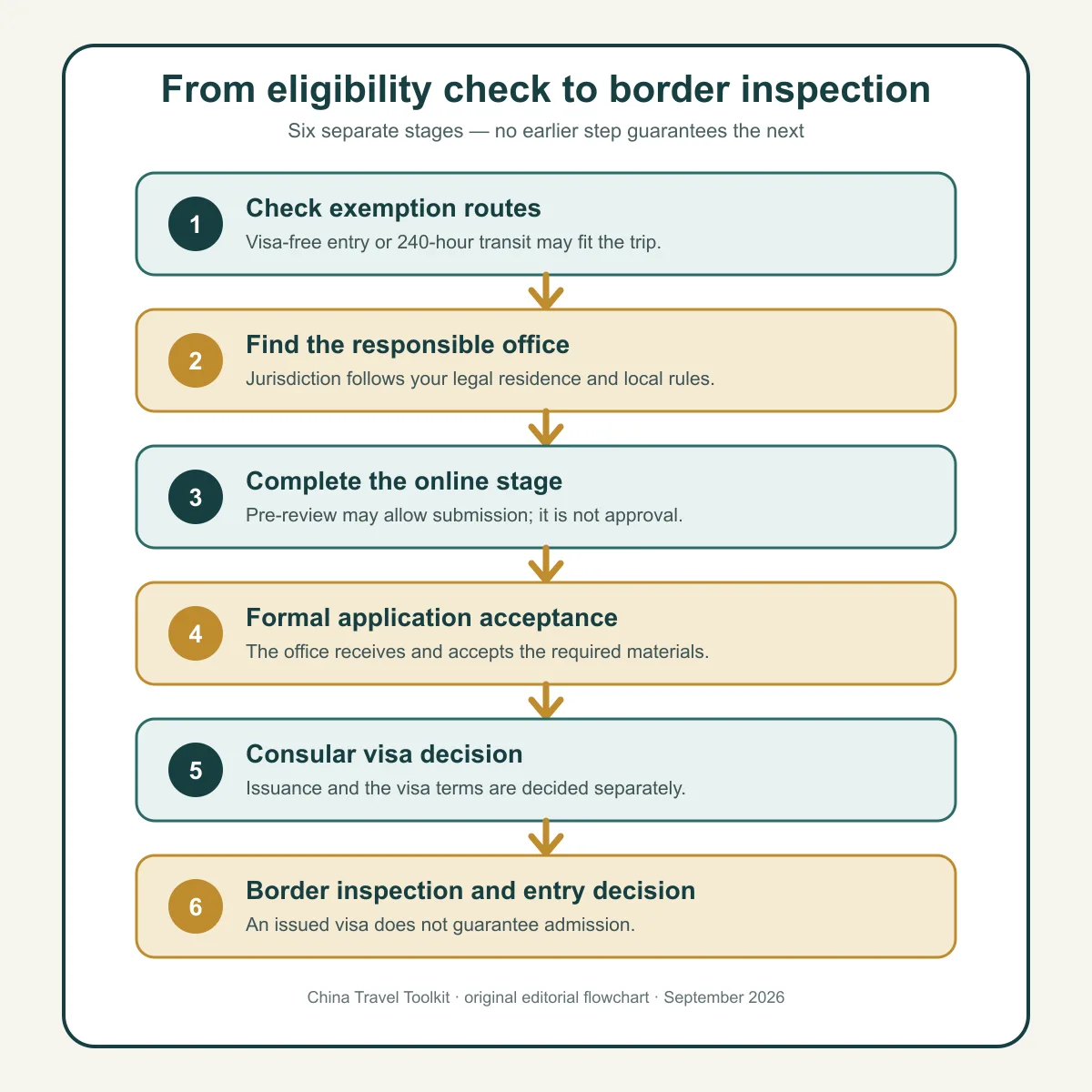
The process has four separate decisions
- An online system may check whether the form and uploads can proceed.
- The office formally accepts the passport and required documents.
- The consular authority decides whether and how to issue the visa.
- Border inspection makes the final decision when you request entry.
Who This Guide Is For
This guide is for a first-time visitor preparing an ordinary mainland China L-visa application. It does not cover work, study, family reunion, journalism, permanent residence, diplomatic travel or travel to Hong Kong or Macao under their separate entry systems.
It also does not replace the instructions of the office handling your application. Official requirements can differ even when two applicants hold the same passport, because they apply from different countries or consular districts.
Step 1: Find the Office That Serves Where You Legally Live
Start with the website of the Chinese embassy or consulate responsible for your current address. In locations served by a Chinese Visa Application Service Center, the mission’s website should direct you to the correct center or application system.
Do not assume you can choose any nearby office. Consular districts can be divided by state, province or territory. If you apply outside your country of citizenship, the local checklist may require proof that you legally reside or stay there, such as a residence permit, visa or immigration record.
- Open the official Chinese mission website for your country of residence.
- Find its consular jurisdiction or service-area page.
- Confirm that your current address belongs to that office.
- Follow its link to the current visa portal or service center.
Office assignments and processing arrangements can change. A search-engine result or an old travel forum is not enough to establish jurisdiction.
Step 2: Read the Local L-Visa Instructions
Look specifically for the ordinary tourist or L-visa page. Save a copy or screenshot of the checklist, submission instructions and fee page you used, together with the date. Confirm whether the process includes an online form, document uploads, preliminary review, an appointment, in-person passport submission, postal service or another locally published route.
There is no reliable global answer to questions such as “Do I need a hotel booking?” or “Can I apply by post?” Current official examples show why: some offices waive flight, hotel and itinerary evidence for L-visa applicants, while other offices request bookings, an itinerary or an invitation letter. An office offering postal return does not prove that postal application is available elsewhere.
Step 3: Prepare the Document Set Required Locally
Official checklists commonly refer to several document categories, but the exact list and format belong to your application office:
- A current passport, its biographical page and the required number of blank visa pages.
- An online application form, confirmation or barcode page.
- A recent photograph that passes the local digital and paper specifications.
- Proof of address, legal residence or legal stay where required.
- Previous passports, previous Chinese visas or documents concerning former Chinese nationality where applicable.
- Tourism evidence—such as transport, accommodation, an itinerary or an invitation—only in the form required by the local checklist.
- Additional evidence for minors, name changes or other circumstances identified by the reviewing office.
Even passport wording varies. Official pages reviewed for this guide use both “more than six months” and “at least six months,” and they do not all require the same number of blank pages. Treat six months as a warning threshold, not a universal guarantee, and follow the stricter wording on your own office’s page.
Keep names, dates and passport details consistent
Enter your name exactly as requested from the passport machine-readable page. If your office asks for bookings, an itinerary or an invitation, check that passport details, travel dates, cities and accommodation information agree across the form and supporting documents.
Do not buy non-refundable travel simply because a generic online checklist says it is required. First confirm what your own office asks for and whether it accepts reservations, an invitation or another form of evidence.
Follow the local photo specification
Official guidance commonly calls for a recent, front-facing color photograph on a light background, but local presentation rules and upload checks can differ. Follow the dimensions and appearance rules shown by your portal. If the upload repeatedly fails, check whether the office tells applicants to bring a printed photo at submission.
Step 4: Complete the Online Stage
Where an online system is used, complete every field carefully and upload only the documents requested for your location. Save the application number, login method, confirmation page and the email address used.
Online pre-review is not a visa decision. A status such as “passport to be submitted” usually means you may move to the formal submission stage. A correction request means the reviewing office wants the specified information changed or supplemented; it is not evidence of either approval or final refusal.
Check the portal and your email regularly. If the office requests a correction, additional document or interview, respond through the method it gives. Do not invent a parallel customer-service route or submit conflicting versions of the same information.
Step 5: Submit Your Passport and Documents
Proceed only when the portal or office instructions say that you may submit. Bring or send the exact confirmation page, passport, originals, copies and photographs listed for your location. Confirm whether an appointment is required and whether someone else, a postal service or an agent may be used.
Do not assume that “online application” means the whole process happens online. In several current workflows, applicants first upload information and later submit the physical passport and documents. The formal acceptance stage begins only when the responsible office receives and accepts the required application materials.
Keep the submission receipt or collection form. If the office accepts payment at this stage, verify the locally published fee, service charge and payment method immediately before visiting or sending the application.
Step 6: Check Fingerprints, Fees and Timing Locally
Fingerprint rules are time-sensitive and locally implemented. For example, the London visa center’s notice reviewed on September 8, 2026 states that qualifying short-term applicants in its jurisdiction are exempt from fingerprint collection through December 31, 2026, while specified long-term visa categories still require fingerprints. Do not apply this notice globally; check the latest notice from your own application office.
Fees depend on factors including nationality, location, service center and service level. Use the current fee table for the office handling your application; do not copy a fee quoted for another country.
Likewise, treat published processing times as estimates. Online review, formal acceptance, requested corrections, interviews, holidays, document return and individual review can all affect timing. Apply with a reasonable buffer, but do not present any number of days as guaranteed.
Step 7: Understand the Visa Decision
Formal acceptance does not guarantee issuance. The consular authority may ask for more information or an interview, and it decides whether to issue a visa. It may also decide the number of entries, validity period and permitted duration of each stay differently from what you requested.
When your passport is returned, check the visa immediately:
- Your name and passport number.
- The visa category.
- The “enter before” date.
- The number of permitted entries.
- The duration of each stay.
If something appears inconsistent, contact the issuing office using its published channel before travelling. Do not interpret the application form or your requested itinerary as the terms of the issued visa.
Step 8: Prepare for Final Entry Inspection
An issued visa allows you to travel to a Chinese port of entry and request admission; it does not guarantee admission. Under China’s Exit and Entry Administration Law, border inspection authorities examine and decide entry.
Travel using the passport containing the visa and for the purpose represented in your application. Keep practical trip evidence—such as your first accommodation address, onward plan and contact details—available if an officer asks about your visit. This is sensible preparation, not a universal arrival-document checklist.
Complete your broader arrival preparation with the China first-trip checklist, and use the China packing list for first-time visitors for documents, power banks, medicine and offline backups.
Common Mistakes to Avoid
- Starting with a generic checklist: identify the office serving your legal residence first.
- Choosing an office by convenience: a nearby center may not serve your address.
- Assuming every L-visa applicant needs flights and hotels: local requirements differ.
- Treating online review as approval: it only moves the application to the next stated stage.
- Using mismatched names or dates: compare the form with every supporting document.
- Relying on an old fingerprint notice: temporary policies require a current local check.
- Booking around a promised processing date: published estimates are not guarantees.
- Assuming the requested visa terms were granted: read the issued visa itself.
Application Checklist
- Rule out visa-free entry and 240-hour visa-free transit for your exact trip.
- Confirm the office and consular district serving your legal residence.
- Open its current L-visa page and save the date checked.
- Confirm the portal, appointment and passport-submission method.
- Prepare only the locally requested document set.
- Check passport validity, blank pages, photo and legal-residence evidence.
- Keep all names, passport numbers, dates and cities consistent.
- Recheck fingerprints, fees, payment method and return options.
- Treat online review, formal acceptance and visa issuance as separate stages.
- After collection, inspect the issued visa and prepare for border examination.
FAQ
Can I apply in a country where I am not a citizen?
Possibly, if the office accepts applications from people who legally reside or stay in its jurisdiction. Expect to provide the proof specified by that office. Do not assume short-term visitor status is sufficient without checking.
Do all China tourist visa applicants need flight and hotel bookings?
No single rule applies worldwide. Some current official instructions waive some tourism evidence, while other offices request an itinerary, bookings or an invitation. Follow the L-visa checklist for your application location.
Does online approval mean my visa is approved?
No. Preliminary online review generally means the form can proceed to passport and document submission. Formal acceptance and the consular decision come later.
Do tourist visa applicants need fingerprints in 2026?
It depends on the current notice issued for your application location. For example, the London visa center currently publishes a temporary exemption for qualifying short-term applicants through December 31, 2026. Other locations or visa categories may apply different requirements, so check your own office immediately before submission.
How long does a China tourist visa take?
Use only the current estimate published by your office and do not treat it as a guarantee. Online review, additional documents, an interview, formal processing and passport return may take separate amounts of time.
Does a valid visa guarantee entry to China?
No. A visa permits you to travel to the border and request entry. Border inspection authorities make the final decision under Chinese law.
Official Sources and Last Verified Date
Last official-source check: September 16, 2026. The final publisher must repeat the local-office, document, fee, fingerprint and submission-channel checks on the actual publication date.
- Chinese Embassy in the United States: visa requirements and procedures
- Chinese Embassy in the United States: guidelines for China online visa applications
- Chinese Visa Application Service Center in Sydney: visa categories and local requirements
- Chinese Visa Application Service Center in Chiang Mai: local visa requirements
- Chinese Visa Application Service Center in London: temporary fingerprint exemption notice
- National Immigration Administration: Exit and Entry Administration Law, Articles 24–25
Official pages can move or be replaced. If a saved link is unavailable, start again from the website of the Chinese mission serving your legal residence rather than relying on an archived third-party checklist.