Foreign visitors can use metros in China without a Chinese bank account, but the easiest payment method depends on the city. In Beijing, Shanghai, Shenzhen and Guangzhou, you can fall back to a single-journey ticket; each city also has its own transit cards and QR codes, while eligible contactless international bank cards now work at selected or network-wide gates under local rules.
Last official-source check: September 8, 2026. Payment support, trial programs, child rules and station facilities can change. Check the local metro operator for your exact city, station, direction and travel date.
Quick Answer
To use a metro in China, first choose a payment method supported by that city. Pass the security check, tap or scan at the entry gate, follow transfer signs without leaving the paid area, and use the same ticket, card or QR code to exit. If a gate rejects your payment, stop trying different methods and ask the station service center to check the journey record.
The safest first-trip setup
- Keep a physical contactless bank card where the city supports it.
- Carry enough RMB cash to buy one ticket at a machine or counter.
- Save the Chinese name of your destination and the correct station.
- Do not depend on one app, one card or one phone battery.
Choose the Right Metro Payment Method
There is no nationwide metro ticket or QR code. Choose the method that creates the least friction for your trip:
- Single-journey ticket: best for a few rides, a failed app setup or an immediate backup.
- Physical transit card: useful for repeated local trips, but purchase, deposit, refund and transport coverage differ by city and product.
- Metro QR code: convenient after activation, but it may require a mobile number, identity verification and an auto-debit payment method.
- Contactless bank card at the gate: the simplest no-app option when your city, gate and card are eligible.
Do not assume that a foreign card linked successfully to Alipay or Weixin Pay will automatically activate every local transport code. The transport operator controls the code, and its identity and payment checks can be different from ordinary shop payments.
Before Entering the Station
Confirm the station name, line and direction before going through the gate. Large railway hubs can contain both a city metro station and a China Railway station; a high-speed rail ticket does not open a metro gate. Save the destination’s Chinese name because English place names and map pins are not always enough to identify the correct exit.
Check the last train for the exact station and direction on the day of travel. Times change by line, date, event, disruption and holiday plan, so this guide does not provide a national last-train time. Allow extra time for security screening, long transfer corridors and luggage.
Prepare maps, payment and translation tools before arrival using our guide to apps to download before visiting China. At the station, look for signs marked Tickets, Customer Service or Service Center if you need help.
For station exits and the final walk, learn how to use Amap in China and save the destination’s Chinese name before you enter the metro.
How to Buy a Single-Journey Ticket
- Find a ticket machine or station service center before the security or fare gate.
- Select English if the machine offers it.
- Choose your destination station. The machine calculates the local fare.
- Pay using a method displayed by that machine or counter. If your card or mobile wallet fails, ask where cash is accepted.
- Keep the ticket until you leave the destination station.
Physical ticket formats differ. Beijing and Shenzhen physical single tickets are tapped at entry and returned to the exit gate. Shanghai also uses a paper QR single ticket that is scanned at both ends. Follow the symbols on the ticket and the instructions at the gate rather than forcing it into a slot.
A single ticket normally covers one passenger and one journey. Do not assume it includes an out-of-station transfer. If you exit through a fare gate, you may have ended that journey and may need another fare to re-enter.
How to Use a Transit Card
Beijing uses products such as Yikatong and the BEIJING PASS; Shanghai has the Shanghai Public Transportation Card and visitor-oriented pass products; Shenzhen uses Shenzhen Tong; Guangzhou uses Yang Cheng Tong and accepted interoperable cards. These are separate local systems, even if some cards or mobile products work beyond one city.
A physical transit card is useful when you expect many local rides and prefer not to open an app at every gate. Before buying, check where the card is sold, the required deposit or purchase fee, how to add value, which transport services it covers and whether any remaining balance can be refunded. Those conditions belong to the specific card, not to “China metro” as a whole.
Tap the same physical card at entry and exit. Do not enter with a plastic card and try to exit with its phone-wallet version unless the operator explicitly says they are treated as the same credential.
QR Codes and Mobile Payment
Each city lists its own metro or public-transport code channels. Beijing uses local ticketing apps such as Yitongxing; Shanghai lists Metro Daduhui and supported Alipay, WeChat and Suishenxing routes; Shenzhen lists Shenzhen Metro, Shenzhen Tong and Tencent channels; Guangzhou lists the Guangzhou Metro app, its WeChat mini-program and Alipay.
Activation may ask for personal information, a mobile number, identity verification and permission to deduct fares automatically. An overseas number or international card can work in some payment scenarios without guaranteeing that a particular city code will activate. Follow the current in-app instructions and keep a non-phone backup.
Once activated, open the correct city’s code, increase screen brightness if necessary, and scan at entry and exit. Do not switch between QR-code platforms during one journey. For wallet setup and independent cash/card backups, use our guide to paying in China as a foreigner.
International Bank Cards at Metro Gates
Direct card entry is expanding, but “international cards accepted” never means every card will work. The card must be contactless and eligible, the gate must support its network, and the issuer can still decline the transaction.
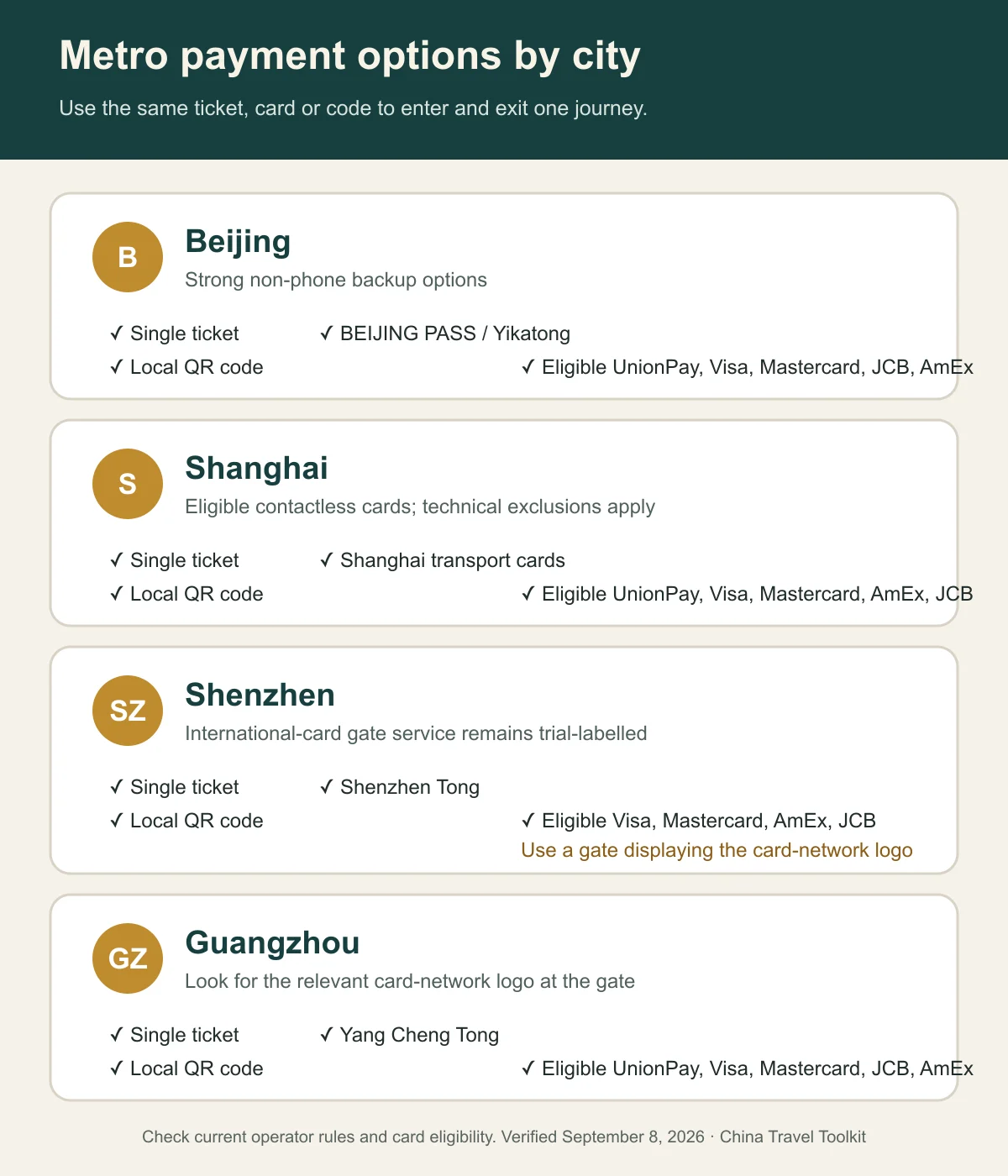
- Beijing: the current official guidance supports eligible contactless UnionPay, Mastercard, Visa, JCB and American Express cards across the urban rail network.
- Shanghai: its full-network Tap to Ride service supports eligible contactless UnionPay, Visa, Mastercard, American Express and JCB cards. Official guidance excludes Type-B chips and cards without offline data authentication, and issuer or card settings can still prevent use.
- Shenzhen: the official international-card service was still described as a trial at the latest check. The city currently reports coverage across 17 operating lines and 432 stations, but passengers must use a payment-enabled gate displaying the relevant Visa, Mastercard, American Express or JCB logo. Do not assume every gate is enabled.
- Guangzhou: official guidance supports eligible contactless overseas Mastercard, Visa, JCB and American Express cards at metro gates displaying the network logo; UnionPay contactless support was already available.
Use the same physical card for entry and exit. If you entered with a bank card, do not exit using cash, a QR code or a different card. Keep the card available after the trip in case an incomplete journey or delayed fare requires review.
Security Check, Entry and Transfer Process
- Security: place bags through the scanner and cooperate with local screening. Restricted-item rules are city-specific and can change.
- Entry: tap the ticket or contactless card, or scan the local QR code. Wait for the gate to confirm before walking through.
- Platform: check the line number, destination direction and platform signs. The station name alone does not tell you which side to use.
- Transfer: follow the transfer signs inside the paid area. Long interchange corridors are common at large hubs.
- Exit: use the same payment medium and select the correct street exit for your destination.
Security queues and temporary crowd controls can add time during events and holidays. Platforms may use floor markings for boarding queues. Let passengers leave the train before entering, keep bags out of the doorway and follow staff directions when access is controlled.
What to Do at the Exit Gate
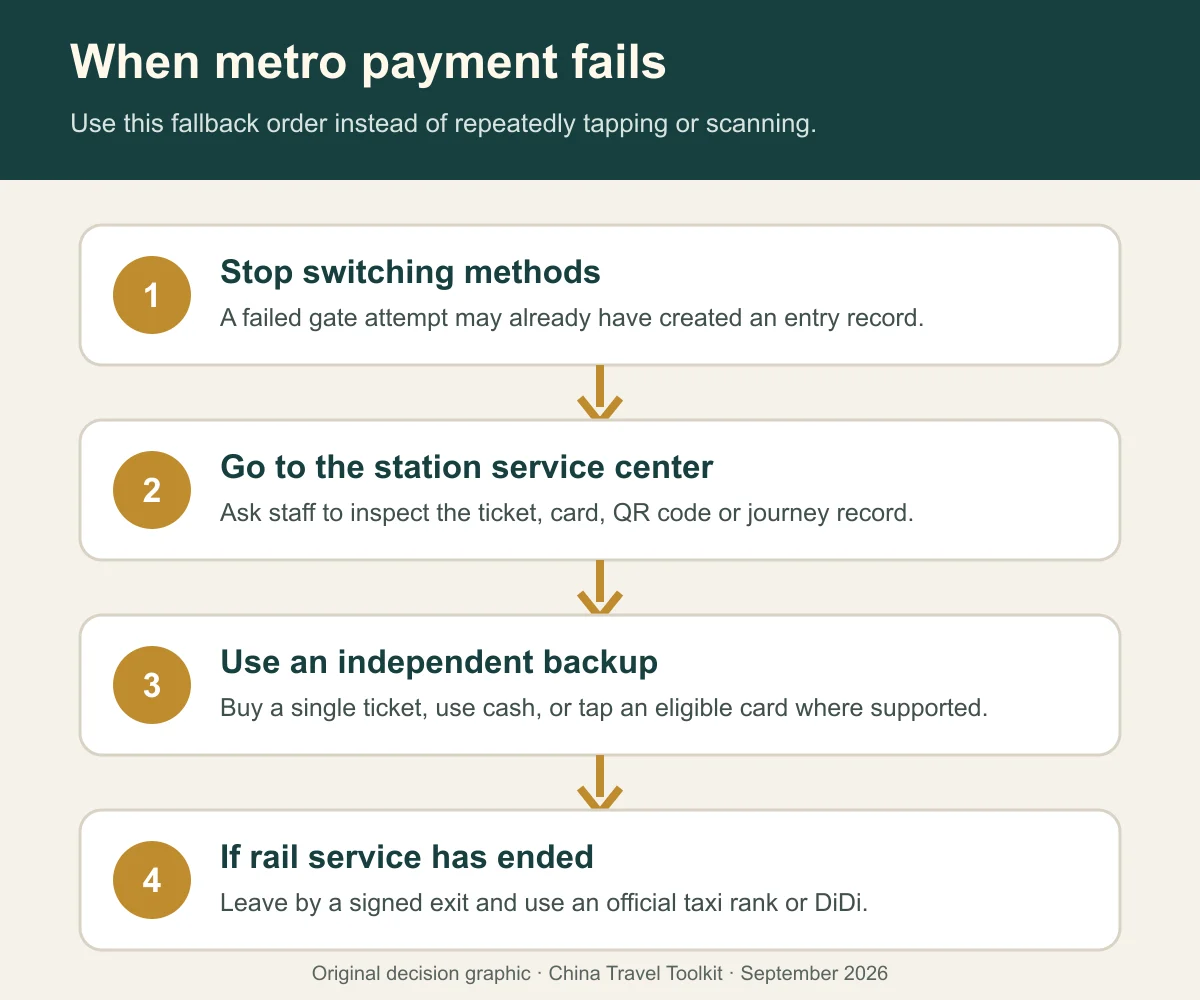
If the gate opens, collect any returned card or receipt and follow the signed exit number. If it does not open, do not repeatedly scan different codes or tap another card. A failed attempt may already have created an entry or exit record.
Take the original ticket, card or phone to the station service center. Staff can check for an incomplete journey, insufficient value, an unreadable ticket, travel beyond the paid distance or a local overtime condition. Pay any fare adjustment through the method the station currently accepts.
Do not generalize Shanghai’s penalties, Shenzhen’s journey-time limit or another city’s maximum-fare treatment. These are local rules. If a direct bank-card journey is incomplete, the operator or card support channel may apply a temporary or maximum-fare deduction while the record is resolved.
Beijing, Shanghai, Shenzhen and Guangzhou Differences
| City | Useful first choice | Phone-free backup | Important limitation |
|---|---|---|---|
| Beijing | Eligible contactless card or local ticket product | Single ticket or BEIJING PASS | Check the exact child, luggage and station-facility rule |
| Shanghai | Eligible contactless card, local QR code or transport card | Service-center ticket purchase | Some contactless-card technologies are excluded |
| Shenzhen | Local QR code, Shenzhen Tong or enabled international-card gate | Cash/physical single ticket | International-card gate service remains trial-labelled |
| Guangzhou | Eligible contactless card or local transport code | Physical ticket or Yang Cheng Tong | Use a gate showing the relevant network logo |
For the city context around the system, see our practical guides for first-time visitors to Beijing, first-time visitors to Shanghai and first-time visitors to Shenzhen. Those pages handle neighborhoods and itineraries; this page owns the metro workflow.
Troubleshooting and Fallback Decision Tree
The QR code will not activate
Follow the current identity, phone-number and payment prompts. If the city code still does not activate, stop troubleshooting at the gate and buy a physical single ticket or ask the service center which independent payment method is available.
The bank card is declined
Confirm that the card is contactless, belongs to a supported network and is being tapped at a gate carrying that network’s logo. If it fails, use another independent method; do not promise that changing one phone or wallet setting will solve an issuer decline.
The gate rejects you after entry
Use the same medium you used to enter. Ask staff to inspect the journey record before trying anything else. Be ready to pay a local fare adjustment if the ticket value, distance or recorded journey is incomplete.
Your phone has no data or battery
Use a physical ticket, stored-value card or eligible contactless bank card where supported. A screenshot of a rotating QR code is not a reliable substitute for the live code.
Children, Luggage and Accessibility
Child rules are not national. Beijing’s specific ticket rule currently allows children 1.3 metres and under to ride free with a paying adult, with staff assistance advised for more than one free child. Shanghai’s current transport-authority rule allows children 1.3 metres and under to ride free with a paying adult; because a newer English municipal guide conflicts with that rule on the exact boundary and number of children, threshold cases and groups with several children should ask station staff. Shenzhen combines height and age rules: children under 1.2 metres or under six may ride free, while qualifying children from 1.2 to 1.5 metres or ages 6–14 can use a local half-fare child product. Guangzhou uses 1.3 metres or statutory school age with valid proof. Ask staff when age and height point to different outcomes.
Luggage limits also differ. Shanghai and Guangzhou publish different size calculations, while Shenzhen requires an extra luggage ticket in a defined intermediate weight/size range and bars larger items. Beijing’s published dimensions should be rechecked against the current operator rule before travel. In every city, staff may refuse an item that blocks passage or creates a safety risk.
Do not assume every exit has a lift. Check station-by-station accessibility information and identify the accessible exit before traveling. Use wide gates and vertical lifts with wheelchairs, strollers or large bags, and ask station staff for assistance. Older stations and individual exits can have different facilities.
When to Switch to Taxi or DiDi
Switch when the metro has stopped, your destination is poorly connected, mobility or luggage makes transfers impractical, or a disruption closes the useful line. Leave through a signed station exit and use an official taxi rank or licensed ride-hailing service. Confirm the pickup point and vehicle plate before entering.
Availability and wait time are not guaranteed, especially after major events or late at night. The full booking, pickup and payment process is covered in our guide to taxis and DiDi in China.
FAQ
Can foreigners use the metro in China?
Yes. Foreign visitors can use station tickets and other locally supported payment methods. The best option depends on the city, and some QR-code or bank-card services have identity, phone, card or gate-eligibility conditions.
Can I tap a Visa or Mastercard directly at the gate?
In the four cities covered here, eligible contactless international cards are supported under city-specific rules. Supported networks, technical requirements and gate coverage differ. Look for the card-network logo and keep a single-ticket backup.
Do I need Alipay or WeChat Pay?
No. They can be convenient for local QR codes, but a physical single ticket is available in the four reviewed systems. Eligible contactless cards and physical transit cards provide additional non-phone options in some cities.
Can I use one metro QR code across China?
Do not rely on that. Codes are issued through city or transport products, and activation and coverage vary. Open the correct code for the city and follow its current instructions.
Do children ride free?
Some children ride free, but the age, height, proof and accompanying-adult rules differ by city. Check the local rule and ask station staff before entering.
What if I miss the last train?
Leave the station through a signed exit and use an official taxi rank or licensed ride-hailing service. Check the pickup point and vehicle details, and do not assume a car will always be immediately available.
Official Sources and Last Verified Date
Last verified: September 8, 2026. This guide uses operator and government sources. Recheck dynamic payment trials, card eligibility, service notices and station facilities before travel.
- Beijing Subway: ticket-use and passenger rules
- Beijing Government: international cards at metro gates
- Shanghai Government: current metro guide
- Shanghai Metro: contactless Tap to Ride conditions
- Shanghai Transport Authority: current passenger rules
- Shenzhen Metro: tickets, luggage and station procedures
- Shenzhen Transport Authority: current international-card gate trial
- Guangzhou Metro: bilingual ticket instructions
- Guangzhou Government: international cards at metro gates
- Guangzhou Transport Authority: passenger rules
- Alipay+: transport-code activation requirements
- Tencent: overseas registration and international-card support
4 container
5 container
6 text 👋 Hi,想聊点什么~
7 text 下笔没话说?
8 text 告诉我主题,文案、标题、Slogan我都行
9 text 名词听不懂?
10 text 别自己搜了,直接问我,三秒给你讲明白
11 text 脑袋空空了?
12 text 一起脑暴,给产品起名、给活动想点子
13 text 方案没头绪?
14 text 思路我来理,框架我来搭,你来做决策
15 image
16 text 新会话
17 image
18 text 历史
19 text entry area (settable)
20 checkbox Description: 联网, Value: 1
21 text 内容由AI生成,仅供参考
22 container side-panel-menu
23 text Chat
24 text 云笔记
25 text 账号
26 text 互动
27 text 通知
28 text 设置
29 link yiban.io/style_center?from=side-panel
30 link yiban.io/dashboard?from=side-panel
31 link yiban.io/pricing?from=side-panel
32 image avatar
33 button 开通
The focused UI element is 1 AXWebArea 127.0.0.1:8766/metro.htm