Quick Answer
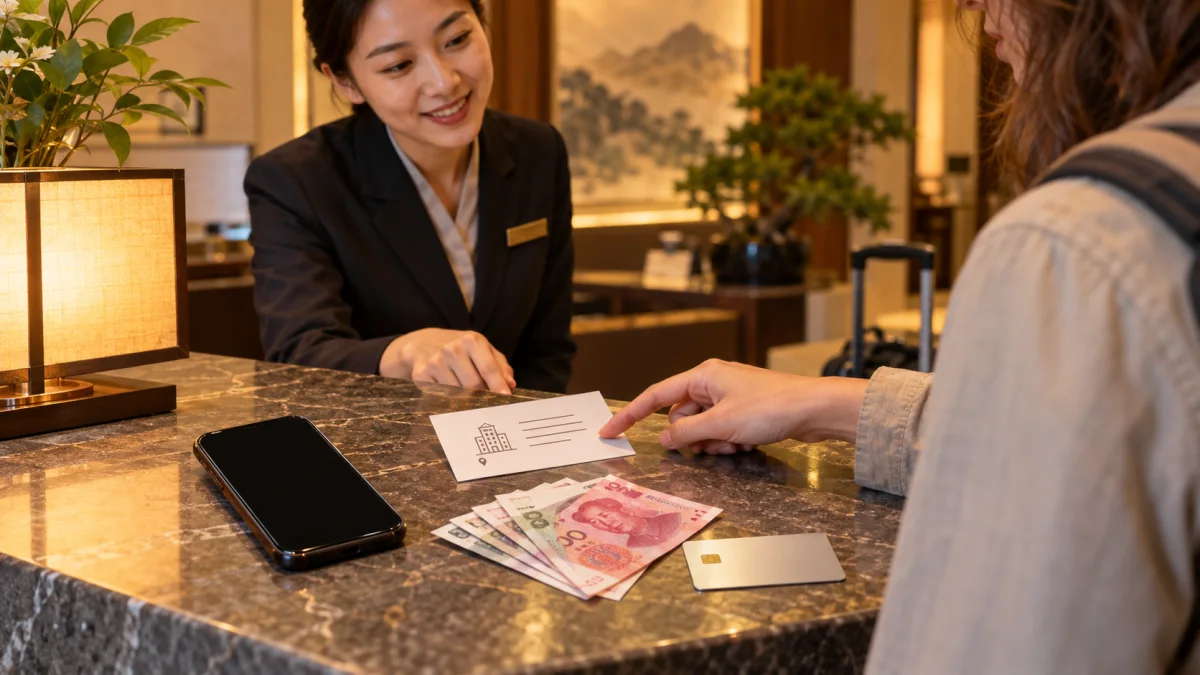
If your phone dies in China, stop relying on QR codes. Use RMB cash or ask whether the merchant accepts your physical card. For transport, go to a staffed counter or official taxi area and confirm the payment method before you travel. Show your hotel name and address from a printed card or another offline copy. Recharge in a safe place before trying to recover app access.
This is a no-phone fallback, not a guide to fixing an Alipay or Weixin Pay account. If the phone works but a wallet payment fails, use the payment failure decision tree instead.
At the Counter: Choose an Independent Payment Method
Check what you actually have with you: RMB notes, a physical bank card, and any physical ticket or transport card valid for this journey. Ask the cashier whether the card network printed on your card is accepted at that counter. A foreign card is not guaranteed to work just because another shop or hotel accepted it.
China’s official visitor payment guidance presents RMB cash and bank cards alongside mobile payment. It also says international cards may be used at compatible ATMs to withdraw RMB. Check the ATM’s card-network logo and your issuer’s rules, fees, PIN, and limits before relying on this as an immediate backup. A bank-card decline is not something a shop assistant can override.
If you only have foreign-currency notes, do not assume a shop can exchange them. The official guidance points visitors to marked bank, exchange, or port facilities. Their location and staffed hours vary; do not send a stranded traveler across town on the assumption that a particular counter is open.
Getting Back to Your Hotel
Metro: Go to a staffed ticket office or station-service point and ask which physical-ticket and payment options are available there. The 2026 official visitor guide’s metro section describes RMB cash and bank-card options for metro tickets or passes, but the exact machine, card network, and city arrangements differ. If the gate needs a code that lives on your dead phone, do not follow another passenger through it; ask staff how to resolve your trip record.
Taxi: Use the official queue or a licensed taxi stand rather than accepting an unsolicited ride. Show the printed Chinese hotel address and ask the driver whether RMB cash or your physical card is accepted before getting in. If you have no workable payment method, ask airport, station, or hotel staff for help with a lawful alternative; do not promise a driver an app transfer you cannot make.
Hotel: Show your printed reservation, address, and passport to reception. Ask about a charging point and the hotel’s current payment options. The 2026 official visitor guide’s hotel section lists cash, bank cards, Alipay, and Weixin Pay for hotels, but tells travelers to check acceptance of international card brands with the hotel in advance. A booking confirmation is not proof that an unpaid balance can be charged to your particular card.
If a Payment Was in Progress When the Phone Shut Off
Do not immediately pay again. Once the phone is charged, check the wallet record and the bank’s official app, then ask the merchant whether the order was received. Keep the amount, time, merchant name, and any paper receipt. If the records disagree, contact the merchant, wallet, or card issuer through its official channel. A dead screen does not establish that a transaction failed.
Do not hand an unlocked phone, card PIN, or verification code to a stranger who offers to “fix” the payment. Ask staff to explain a payment option rather than letting someone operate your account.
Prepare the Fallback Before You Need It
- Keep a modest amount of RMB cash in useful denominations, plus a physical card stored separately from your phone.
- Save your hotel name, Chinese address, and the hotel’s public contact number on a small offline card. Keep any full booking confirmation separately and secure for check-in; do not copy the full reference onto the address card. A screenshot stored only on a dead phone is not an offline fallback for this scenario.
- Carry a charged power bank that meets your transport operator’s current battery rules, and know where your charging cable is.
- Before boarding a metro or ordering a ride, make sure you have enough battery to complete any phone-based exit or payment step—or choose a physical option from the start.
The first 72 hours guide helps organize arrival details, while the China payment guide explains why cash, cards, and mobile wallets should be independent layers.
Official Sources and Last Checked
Official guidance checked October 16, 2026:
- Ministry of Commerce: 2026 Guide to Working and Living in China
- 2026 guide: metro ticket options
- 2026 guide: hotel check-in and payment options
- 2026 guide: foreign-currency exchange
- People’s Bank of China / Ministry of Culture and Tourism: Guide to Payment Services in China
- State Council: payment service guide for overseas visitors
Payment acceptance, ATM support, station procedures, and staff availability are local and changeable. This guide does not promise that every merchant takes an international card, that every ATM can dispense cash for your card, or that a taxi accepts a particular payment method.