City Guide
Best Things to Do in Shenzhen for First-Time Visitors
By Mars · Based in Shenzhen · Last verified: September 21, 2026
Quick Answer
For a first visit to Shenzhen, choose sights by area rather than building one citywide checklist. A practical first day combines Futian’s civic center and Lianhua Hill with either Huaqiangbei or the Houhai waterfront. With a second day, add a western cluster such as Nantou, OCT, Qianhai, or Shekou. Use the metro for long moves, check the final walk in Amap, and verify any ticket or reservation on the attraction’s official channel before leaving.
This guide answers where to go and how to group the stops. For entry preparation, hotels, connectivity, and arrival planning, use the Shenzhen guide for first-time visitors.
Best Things to Do in Shenzhen
Shenzhen is strongest when you treat it as a collection of different urban experiences: a planned civic center, electronics commerce, waterfront parks, contemporary cultural venues, theme parks, older commercial streets, and coastal neighborhoods. The city is large, so a short list that ignores geography can waste more time in transit than at the sights.
For most first-time visitors, these are the most useful experience types:
- Modern Shenzhen: Civic Center, Lianhua Hill, and the Futian skyline.
- Technology and commerce: Huaqiangbei, visited with a clear purpose rather than as a guaranteed shopping bargain.
- Waterfront Shenzhen: Talent Park, Shenzhen Bay, Qianhai, or Shekou.
- Theme parks and entertainment: Window of the World or another ticketed venue that genuinely matches your interests.
- Older urban texture: Dongmen or Nantou as a contrast to the newer business districts.
- A slower local day: parks, museums, neighborhood meals, and one evening waterfront instead of a race across districts.
No attraction belongs on every itinerary. Choose the places that fit your interests, arrival point, weather, mobility, and time available.
Plan Shenzhen Attractions by Area
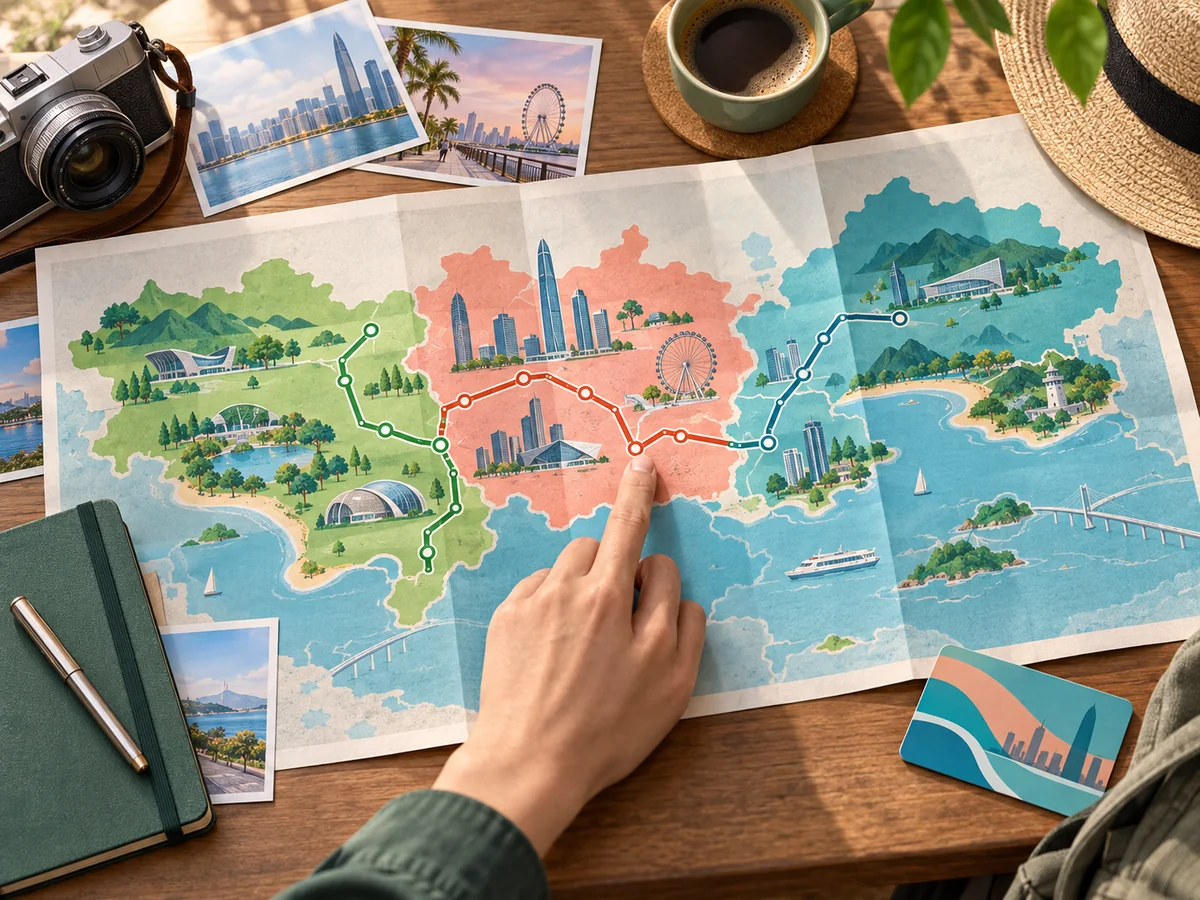
Futian: civic spaces, skyline views, and Huaqiangbei
Futian is the easiest starting area for many first visits because it combines central transport with several different experiences.
Begin around Lianhua Hill Park and the Civic Center for an overview of modern Shenzhen. The hill and surrounding civic district work well as an outdoor introduction, but weather can reduce the view. Museums and cultural venues in the area keep their own opening and admission arrangements, so check the specific venue rather than assuming that every building follows the same rule.
Continue to Huaqiangbei if electronics, retail systems, or Shenzhen’s technology culture interest you. It is a working commercial district, not one museum with a single entrance. Individual malls and vendors have different hours, warranties, payment methods, and return policies. Browse first, compare exact product models, and do not assume that an item is compatible with networks or electrical standards in your home country.
Futian also makes a sensible base for a short visit from Hong Kong. If you arrive by high-speed rail, save the exact station name and allow time to find the separate railway area before your return departure.
Houhai and Shenzhen Bay: waterfront parks and an evening skyline
The Houhai area works well for a less rushed afternoon or evening. Shenzhen Talent Park and the surrounding Shenzhen Bay waterfront provide open-air views and a modern skyline without requiring a packed attraction schedule.
Do not build the entire evening around an assumed light or drone show. Programs can be announced for particular dates and can change because of weather, crowd controls, or special events. Choose the area because the waterfront itself suits your plan, then treat a confirmed show as a bonus.
This cluster pairs naturally with a meal in Houhai or another nearby commercial area. Confirm the correct park entrance and the route back to your hotel before the metro’s final useful connection.
OCT and Window of the World: paid attractions and easy alternatives
Window of the World is a paid theme park centered on replica landmarks and entertainment. It can take a substantial part of a day if you enter. Check the official ticket channel, operating notice, and any date-specific admission requirement before buying; do not rely on an old price or timetable copied into a blog.
If the theme does not interest you, skip the paid visit rather than adding it only because it appears on many lists. Nearby OCT Harbour can serve as a walk, meal, or evening stop, but its shops, events, performances, and neighboring venues maintain separate schedules and access rules.
The OCT National Wetland Park is not the same thing as walking through OCT Harbour. Treat it as a separate venue and verify its current access procedure directly.
Qianhai, Nantou, and Shekou: western Shenzhen
Western Shenzhen rewards slower planning. Choose one or two of these rather than trying to complete all of them in a few hours.
Qianhai’s parks and greenways offer waterfront space and views toward the wider bay area. The official Qianhai park information should control current entrances and access. Save the exact section you intend to visit because “Qianhai” covers a broad area, and a general map pin may not lead to the entrance you want.
Nantou Ancient Town provides a historical and urban-renewal contrast to Shenzhen’s newer districts. Individual galleries, shops, exhibitions, and courtyards may set their own hours. Visit for the neighborhood and public spaces rather than assuming every interior venue will be open.
Shekou works for a waterfront walk, food, and a more relaxed evening. It is also relevant to some ferry journeys, but city ferries and the restricted Hong Kong International Airport airside transfer are different services. Verify the exact terminal and service before travel.
Luohu and Dongmen: an older commercial side of the city
Dongmen Old Street is useful when you want busy pedestrian commerce, casual food, and an older central-Shenzhen atmosphere. It pairs naturally with a Luohu arrival or departure, but it is not close to every western attraction.
Crowded commercial streets require ordinary city awareness: keep valuables secure, check prices before buying, and use a mapped meeting point if your group separates. A food stall’s popularity is not proof of an allergy-safe kitchen or a particular hygiene standard.
Dapeng and the eastern coast: a separate day
The Dapeng Peninsula and Shenzhen’s eastern coastal areas should normally replace a central-city sightseeing day, not be added to it. Travel time and road conditions can be significant, especially on weekends, holidays, or beach-weather days.
Choose this option only when coast, beaches, hiking, or heritage is a central reason for the visit. Verify the destination, access rules, weather, and return transport. Do not plan a tight Hong Kong return after a distant eastern-Shenzhen day without a large buffer.
One-Day, Two-Day, and Three-Day Choices
One day: choose one coherent route
For a first day focused on modern Shenzhen:
- Start around Lianhua Hill and the Civic Center.
- Choose Huaqiangbei for technology and commerce or a cultural venue that is confirmed open.
- Move to Houhai and finish at the Shenzhen Bay waterfront.
For a western route:
- Start at Nantou or a defined Qianhai park section.
- Choose a paid theme-park visit or continue with OCT Harbour.
- Finish in Shekou or Houhai according to your hotel and return route.
Do not combine both routes at full length. Shenzhen’s scale makes that plan rushed even when the metro journey looks simple.
Two days: central city plus western Shenzhen
Use day one for Futian, Huaqiangbei, and one evening waterfront. Use day two for Nantou, OCT, Qianhai, or Shekou. If Window of the World is a priority, give it the time it needs and remove another western stop.
Three days: add depth, not distance for its own sake
On a third day, choose one theme:
- a museum and neighborhood day in central Shenzhen;
- a slow Qianhai–Nantou–Shekou day;
- Luohu and Dongmen;
- or a separately planned eastern-coast day.
Three days do not require visiting every district. A smaller plan with time for meals and wrong-exit recovery is usually more useful than a long attraction count.
How to Travel Between Shenzhen Attractions by Metro
Use the metro for the long part of the journey, then evaluate the final walk. Large parks, malls, and cultural complexes can be far from the station exit even when the station name looks correct.
Before entering:
- save the attraction’s Chinese name and official address;
- confirm the line, direction, transfer station, and exit;
- check the last useful train for the route back;
- keep a separate payment method or physical-ticket fallback;
- and allow extra time for security screening and long interchange corridors.
The China metro guide covers tickets, cards, QR codes, eligible contactless bank cards, gates, transfers, and failure recovery. For the exit and final walking route, use the Amap guide for China and compare the venue’s official entrance information.
Which Shenzhen Attractions Need Reservations or Advance Tickets?
There is no citywide rule that applies to every attraction. A public park, municipal museum, special exhibition, theme park, wetland venue, observation deck, and ticketed performance can all use different systems.
Shenzhen removed general advance-reservation requirements at many public attractions in 2024, but the official notice kept ticket requirements and capacity controls, and later venue notices show specific exceptions. OCT National Wetland Park uses reservations, and the Shenzhen Natural History Museum has used high-demand real-name booking. Treat the live venue notice as the controlling source.
Use this order:
- Open the attraction’s official website, official WeChat account, or government listing.
- Check the notice for your exact visit date, not a general description from an old article.
- Confirm whether foreign passports are accepted in the booking field and enter the document exactly as shown.
- Save the confirmation, QR code, order number, Chinese venue name, and entrance instructions offline.
- If the official channel is unusable, contact the venue before paying a third party.
Never invent a passport workaround. If a booking form does not support your document, ask the venue for its current foreign-visitor procedure. The wider Hong Kong–Shenzhen border crossing comparison is separate from attraction admission and should be checked independently when arriving from Hong Kong.
Shenzhen Weather and Seasonal Planning
Shenzhen has a humid subtropical climate. Heat, humidity, heavy rain, thunderstorms, and tropical-cyclone conditions can affect outdoor routes, coastal plans, ferries, and evening events. Weather is not only a comfort issue: it can change venue access and the practicality of long walks between metro stations and park entrances.
On the day:
- check an official local forecast and any severe-weather warning;
- move indoor venues earlier if the afternoon forecast is poor;
- carry water and sun protection in hot conditions;
- avoid exposed coastal or hillside routes during severe weather;
- and confirm that a ticketed venue is operating before traveling across the city.
Do not attach permanent “best month” promises to a city with variable weather. Match the route to the current forecast and your tolerance for heat and rain.
Is a Shenzhen Day Trip from Hong Kong Realistic?
Yes, a Shenzhen day trip can work when your entry eligibility is clear, you start early, choose one compact area, and protect enough time for the return. It is not realistic to treat border formalities as a fixed short transfer or to combine distant eastern Shenzhen with a tight evening crossing.
Choose the crossing by your Hong Kong origin and Shenzhen destination. High-speed rail can suit West Kowloon to central Futian; Lo Wu/Luohu and Lok Ma Chau/Futian Checkpoint can suit East Rail connections; road routes serve other needs. Use the border guide above to compare them, then check the Futian–West Kowloon station walkthrough if you choose the train.
Before leaving Hong Kong, confirm both Mainland China entry eligibility and the ability to return to Hong Kong. A transport ticket is not immigration permission. Work backward from the last practical connection rather than only the control point’s published closing time.
Frequently Asked Questions
What are the best areas for a first visit to Shenzhen?
Futian is the easiest all-around introduction. Add Houhai for a waterfront evening. With more time, choose one western cluster around Nantou, OCT, Qianhai, or Shekou.
Is Shenzhen easy to explore without a car?
Many major areas are accessible by metro, but the final walk can be long and the city is not one compact center. Use the metro for long journeys, verify the correct exit, and use a licensed taxi or ride-hailing service when luggage, weather, mobility, or distance makes the final leg impractical.
Should I visit Window of the World?
Visit if replica landmarks and a full theme-park experience appeal to you. Check the current official ticket and operating information first. If the theme is not a priority, use the time for waterfronts, neighborhoods, or cultural stops instead.
Can I see Shenzhen in one day?
Yes, but choose one coherent route. Futian plus Houhai or one western-Shenzhen cluster is more realistic than attempting Futian, Luohu, Nanshan, and the eastern coast together.
Do I need to book every attraction in advance?
No single rule covers every venue. Check each official channel. Some public outdoor spaces need no ticket, while ticketed attractions, special exhibitions, museums, wetlands, or events may use reservations or capacity controls.
Which map should I use in Shenzhen?
Amap is a useful primary tool for local place names, metro exits, and walking routes. Save the official Chinese name and address, and keep an offline note in case mobile data or the app fails.
Official Sources and Last Verified
- Shenzhen Government Online: official travel guide
- Shenzhen Government: reservation-policy update for cultural and tourism venues
- Qianhai Authority: parks and greenways
- Nanshan District: Window of the World
- Nanshan District: OCT Harbour
- Shenzhen Government Online: Shenzhen Talent Park
- Shenzhen Government: OCT National Wetland Park
- Shenzhen Culture Authority: Natural History Museum opening
- Shenzhen Meteorological Bureau: climate overview
- Shenzhen Meteorological Bureau: current warnings
- Shenzhen Port Office: control-point guide
- Hong Kong Immigration Department: control points
- MTR High Speed Rail journey planner
Official-source review completed September 21, 2026. Recheck attraction admission, reservations, opening arrangements, weather warnings, transport schedules, and border operations on the intended visit date.