City Guide
What to Eat in Shenzhen: A First-Time Visitor’s Food Guide
By Mars · Based in Shenzhen · Last verified: September 21, 2026
Quick Answer
For a first food experience in Shenzhen, start with Cantonese staples such as dim sum, rice-noodle rolls, roast meats, congee, soup, clay-pot dishes, and seafood, then explore the regional Chinese food brought by people from across the country. Choose restaurants by the meal and neighborhood you already plan to visit, not by an unsupported “top ten” ranking. Keep a translation tool ready, confirm prices and portion sizes before ordering, and state allergies or dietary limits in writing.
This guide focuses on what to eat and how to order. Use the Shenzhen guide for first-time visitors for arrival, hotels, neighborhoods, and city logistics.
Shenzhen Food Culture for First-Time Visitors
Shenzhen is a migrant city in Guangdong. Cantonese food is an important local foundation, but the everyday dining scene also reflects people and cuisines from across China. That makes Shenzhen a good place to try both Guangdong traditions and regional dishes without pretending that one short list defines the city.
The most useful approach is to understand meal types:
- breakfast counters for congee, buns, noodles, or rice-noodle rolls;
- Cantonese tea houses for dim sum;
- casual restaurants for roast meats, rice, noodles, soups, and clay-pot dishes;
- seafood restaurants where the species, weight, and cooking method should be confirmed;
- food courts and malls for easier visual ordering and mixed groups;
- and specialist regional restaurants when you want Sichuan, Hunan, northern, Muslim Chinese, or other cuisines.
Do not treat social-media popularity as proof of quality, authenticity, current opening, allergy controls, or fair pricing. A useful recommendation should explain the food and ordering process, not only repeat a viral restaurant name.
Foods to Try in Shenzhen and Guangdong
Dim sum and tea-house dishes
Dim sum is a practical introduction to Cantonese food because a group can share several small dishes. Common choices include shrimp dumplings, siu mai, steamed buns, rice-noodle rolls, turnip cake, chicken feet, and steamed ribs. Recipes vary, and fillings or sauces may contain pork, shrimp, shellfish, peanuts, sesame, soy, or other allergens even when they are not obvious.
At some restaurants you order from a paper sheet; at others you scan a QR code or point to a menu. Ask whether tea is charged per person and whether any table or service charge applies before ordering if the menu is unclear.
Rice-noodle rolls, congee, and breakfast
Rice-noodle rolls, known as chang fen (肠粉), may be filled with egg, beef, pork, shrimp, or vegetables and served with sauce. Congee can be plain or include meat, fish, preserved egg, or other ingredients. Steamed buns, soy milk, noodles, and fried dough are also common breakfast choices.
Breakfast shops may be busiest early and may have limited English. Save the dish name in Chinese, point to a picture only after confirming the filling, and keep a payment backup.
Cantonese roast meats
Roast goose, roast duck, char siu, and crispy pork are commonly served with rice or as shared plates. The exact meat, cut, sauce, and portion should be confirmed. Char siu is pork, and roast-meat sauces can contain ingredients that matter for allergies or dietary restrictions.
Soups, clay-pot dishes, and family-style meals
Cantonese meals often include soup and several shared dishes. Clay-pot rice and clay-pot dishes can develop a crisp base and may contain preserved meat, chicken, eel, mushrooms, or vegetables. “Vegetable” dishes may still use meat stock, oyster sauce, dried seafood, or lard, so the English name alone is not enough for strict diets.
Seafood
Shenzhen’s coastal setting makes seafood a common choice, but the safest ordering rule is procedural: identify the exact seafood, ask whether the price is per dish or by weight, confirm the unit, agree on the cooking method, and review the amount before the kitchen begins.
If a tank or market display is used, ask staff to show the weighed item and price. Do not rely on an unlabeled photograph or assume that all condiments and broths are free of shellfish.
Regional Chinese food beyond Cantonese cuisine
Shenzhen also offers food from Sichuan, Hunan, Chaoshan, northwest China, northeast China, Yunnan, and many other regions. This variety is part of the city’s identity. If you are sensitive to heat, ask about both fresh chili and chili oil; “not very spicy” is subjective.
Try regional food when it matches your interests, but avoid claiming that a restaurant is the city’s “most authentic” without evidence. Staff, chefs, menus, and ownership can change.
Breakfast, Dim Sum, Main Meals, and Street Snacks
Breakfast
Choose a nearby shop with clear turnover and an order you can identify. A simple first breakfast might combine congee or soy milk with a bun or rice-noodle roll. Ask what is inside before eating if you avoid pork, shellfish, peanuts, eggs, or dairy.
Dim sum or lunch
Dim sum works best with two or more people because you can share dishes. Start with a small order and add more. QR menus sometimes default to large portions or promotional bundles, so check the quantity before paying.
Dinner
For a Cantonese dinner, choose one protein, one vegetable, rice or noodles, and soup according to the group size. Ask staff to recommend the number of dishes, but confirm the price and portion rather than accepting an open-ended order.
Street snacks and food streets
Food streets and market-style areas are useful for seeing many options, but “street food” does not describe one safety standard. Prefer food cooked thoroughly in front of you, choose vendors with clean handling and steady turnover, and be cautious with food that has been sitting uncovered or at an uncertain temperature.
For skewers or mixed displays, confirm the price basis before selecting several items. A posted number may refer to one piece, one portion, or a weight unit.
Visitor-Friendly Areas for Exploring Food
Shenzhen does not require a food-only journey across the city. Add meals to the district you are already visiting.
Futian
Futian has malls, office districts, residential areas, tea houses, food courts, and restaurants across many price levels. It is a practical first choice for mixed groups because menus, photos, and mall information can reduce ordering friction.
Luohu and Dongmen
Luohu and Dongmen offer dense commercial dining, casual snacks, and older city-center energy. Crowds and many similar storefronts make it important to verify the exact branch and map pin.
Nanshan, Houhai, and Shekou
Nanshan and Houhai combine mall dining with technology and business districts. Shekou has a broad mix of Chinese and international options. These areas work well after a waterfront visit, but a district name is too broad for navigation; save the specific restaurant and entrance.
Neighborhood restaurants
Residential neighborhoods can provide excellent everyday meals, but they may have less English and fewer tourist-oriented booking tools. Use photos and Chinese text for communication, and begin with a simple order rather than asking staff to interpret a long dietary explanation during a rush.
Use the China navigation app guide to check the exact branch, recent listing details, station exit, and walking route. A map listing is useful evidence of location, not a guarantee of current opening or service quality.
How to Order with English or Translation Tools
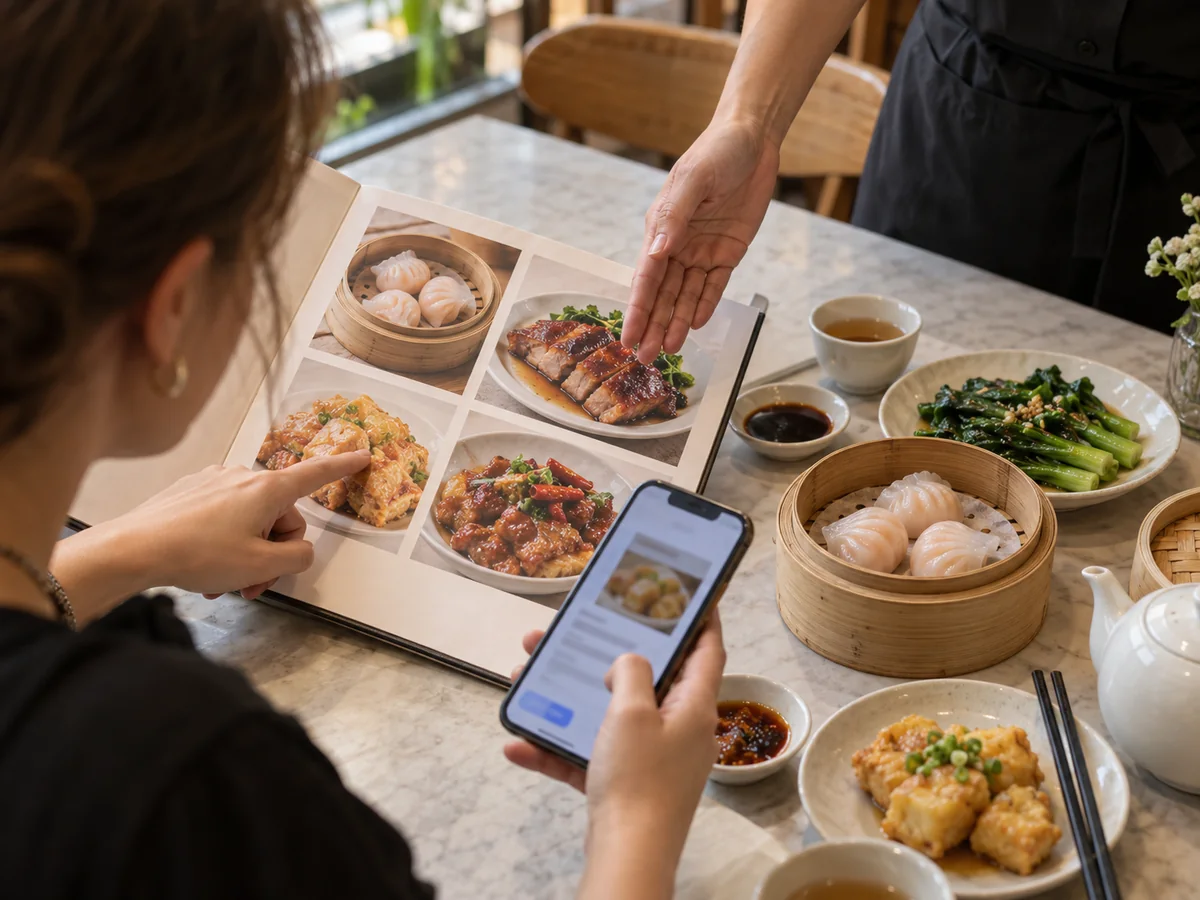
Prepare a short Chinese note before the meal. Keep each request separate and concrete.
Useful prompts include:
- “What is this dish?” — 这是什么菜?
- “Does this contain pork?” — 这个有猪肉吗?
- “Does this contain peanuts?” — 这个有花生吗?
- “I am allergic to shellfish.” — 我对贝类过敏。
- “No meat or fish stock.” — 不要肉,也不要鱼汤。
- “Please show me the total price before ordering.” — 点菜前请告诉我总价。
A translation app can help with a printed menu, but camera translation may misread ingredients, units, or dish names. Show the original Chinese text alongside the translation and ask staff to confirm. The translation apps guide for China explains camera, voice, text, and offline backups.
For QR ordering:
- Confirm that the code belongs to the restaurant and table.
- Check the branch, table number, portion, quantity, and selected options.
- Review the total before payment.
- Take a screenshot of the order if you may need staff help.
- If the mini-program requires an unsupported phone number or payment method, ask for a paper menu or staff-assisted order.
Do not hand over sensitive identity or payment information to an unofficial helper merely to complete a meal order.
Paying at Restaurants in Shenzhen
Mobile payment is common, but travelers should keep independent backups. Alipay and Weixin Pay may allow eligible international users to register and link supported cards, subject to current identity, card, fee, and transaction rules. Cash in renminbi remains legal tender, while bank-card acceptance varies by restaurant and terminal.
Before paying:
- verify the merchant and amount on the screen;
- confirm whether the bill includes tea, service, tableware, or other charges;
- keep the paper or digital receipt;
- and do not let a failed mobile payment leave you without another method.
Set up and test the Alipay guide for foreign visitors before travel. The payment setup is separate from QR-code ordering; a menu may open successfully even when your chosen payment method does not.
Vegetarian, Allergy, and Halal Needs
Vegetarian and vegan food
“Vegetable dish” does not necessarily mean vegetarian. Broth, oyster sauce, fish sauce, dried shrimp, lard, or meat garnish may be used. State what you do not eat rather than relying only on the word “vegetarian.” For strict vegan needs, mention eggs, dairy, honey, broth, and shared cooking oil separately.
A dedicated vegetarian restaurant can reduce ambiguity but does not remove the need to confirm your own restrictions.
Food allergies
Translate the exact allergen and the consequence clearly. Ask about sauces, stock, garnish, cooking oil, and shared equipment. If cross-contact could cause a severe reaction, a busy restaurant that cannot give a clear answer is not a safe choice.
Carry prescribed medication and emergency information according to your clinician’s advice. A travel article cannot guarantee that any kitchen is allergen-free.
Halal requirements
Look for the Chinese term 清真 (qingzhen) and prefer a clearly identified halal restaurant when strict compliance matters. A dish without pork is not automatically halal; alcohol, stock, meat sourcing, preparation surfaces, and cross-contact may also matter.
Ask the restaurant directly about the standard you require. Do not describe an ordinary noodle or seafood restaurant as halal based only on a user review or one menu item.
Food Safety and What to Do If Something Goes Wrong
Choose food that is cooked thoroughly and served hot, and use safe drinking water. Wash or sanitize hands before eating. Be cautious with raw or undercooked seafood, meat, eggs, unpasteurized products, and food held at an uncertain temperature, especially if you are pregnant, immunocompromised, older, or traveling with young children.
If a meal creates a pricing, hygiene, or illness concern, keep:
- the receipt or order page;
- payment record;
- restaurant name, address, and table information;
- photographs of the dish, menu, and posted price;
- platform messages;
- and any medical record or diagnosis.
Contact the restaurant or ordering platform first for an ordinary order problem. For a consumer complaint in Shenzhen, the current municipal guidance routes complaints through 12315; the 12345 government service hotline can also direct a non-emergency issue. These channels do not guarantee a refund, compensation, test result, or enforcement outcome.
Seek medical care first for severe or worsening symptoms, breathing difficulty, signs of dehydration, blood in vomit or stool, neurological symptoms, or a serious allergic reaction. Call local emergency services when urgent. Do not self-induce vomiting or rely on an article for diagnosis or medication instructions.
Frequently Asked Questions
What food is Shenzhen known for?
Shenzhen is a Guangdong city with strong Cantonese food traditions and a dining scene shaped by people from across China. Dim sum, rice-noodle rolls, congee, roast meats, soups, clay-pot dishes, and seafood are useful starting points, but no short list represents every neighborhood or community.
Is it easy to order food in English?
English availability varies. Malls and larger restaurants may have photographs or some English, while smaller shops may not. Save dish names in Chinese, use camera translation carefully, and confirm ingredients, portion, price, and branch.
Can foreign visitors pay cash at Shenzhen restaurants?
Renminbi cash remains legal tender, although an individual counter may be optimized for QR payment. Carry reasonable denominations and another payment option. Do not rely on one app, card, or cashier being able to solve every payment failure.
Is Shenzhen good for vegetarians?
There are vegetarian restaurants and vegetable-forward dishes, but sauces, broth, garnish, and cooking oil can contain animal products. State the exact restriction and choose another restaurant if staff cannot confirm it.
How do I find halal food in Shenzhen?
Search for 清真 and verify the exact restaurant and your required standard. “No pork” alone is not enough to establish halal preparation.
Is street food safe in Shenzhen?
No category is automatically safe or unsafe. Prefer clean handling, high turnover, thorough cooking, hot service, and clearly displayed prices. Your health circumstances may require avoiding raw or undercooked items.
Official Sources and Last Verified
- Shenzhen Government Online: official travel guide
- Shenzhen Government: food culture and local dish standards
- Shenzhen Commerce Bureau: bilingual-menu initiative
- Shenzhen Government: alternative ordering methods for QR-code dining
- Ministry of Culture and Tourism / People’s Bank of China: payment guide
- Shenzhen Market Regulation: 2026 dining food-safety guide
- Shenzhen Market Regulation: current complaint channels
- Shenzhen CDC: foodborne-symptom advice
Official-source review completed September 21, 2026. Recheck restaurant listings, menus, payment support, complaint channels, and health guidance when planning or responding to a real incident.
Before departure, finish the first-trip China checklist so maps, translation, payment, and offline backups are ready before the first meal.